Custom furniture lead time: approx. 6-8 weeks. Need it sooner? Let us know.


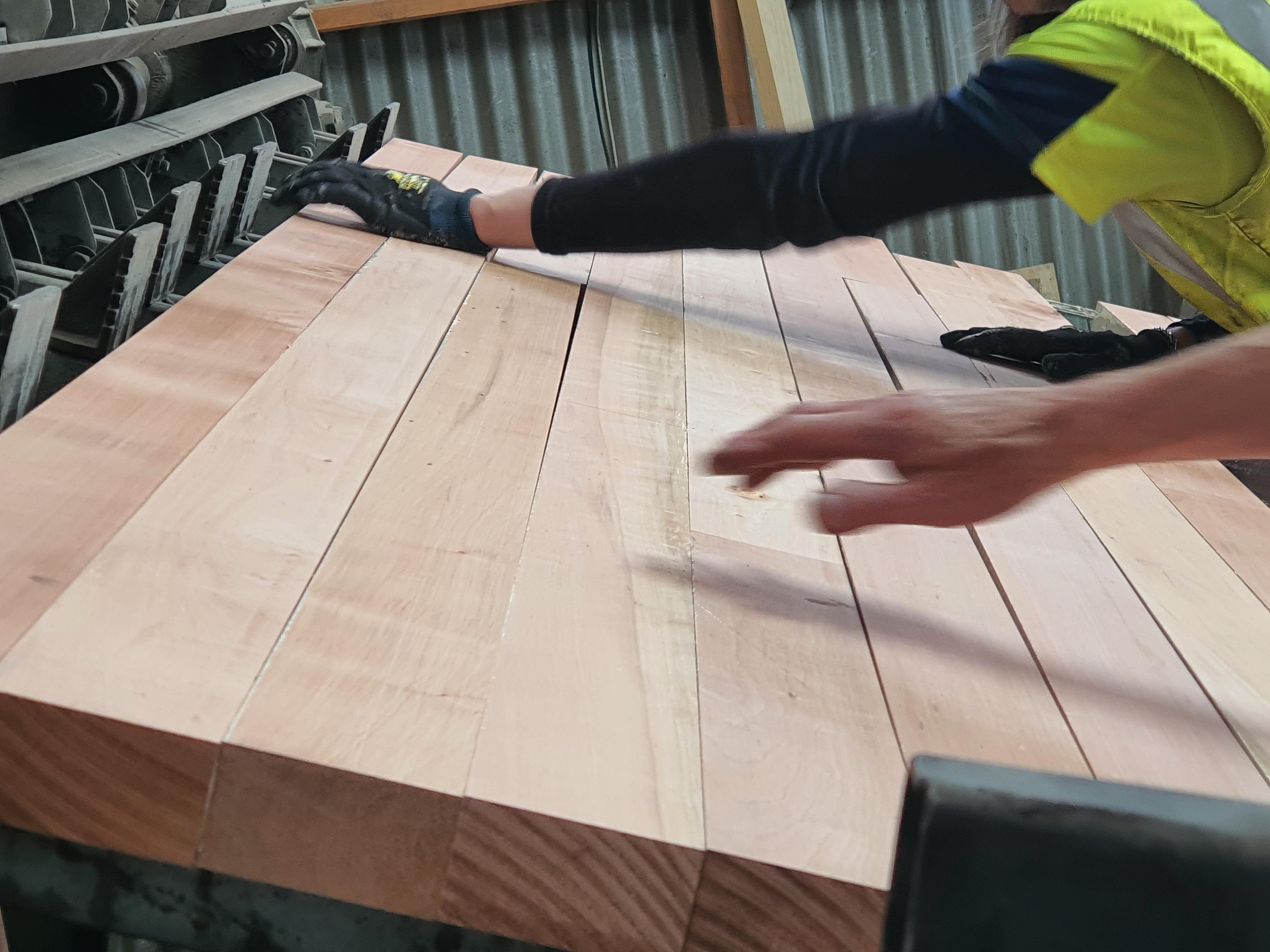
The Making Of: Tabletops and Timber Panels
A good timber tabletop looks simple when it is finished. The work is in everything that happens before that: choosing the boards, setting the grain, laminating cleanly, letting the panel cure, cutting accurately, sanding properly, and finishing it so the timber still feels like timber.
In our Christchurch workshop we make timber panels for dining tables, benchtops and commercial projects. Some are one-off pieces for a family home. Others are repeatable panels for fit-outs where consistency matters as much as character.
What we mean by a timber panel
A tabletop or benchtop panel is usually made from multiple dressed boards laminated together. That lets us choose boards for colour, grain and stability, then create a finished panel at the size and shape the project needs.
For custom work, that is useful. A kitchen benchtop, boardroom table, hospitality table run or oversized dining table rarely fits a standard off-the-shelf size neatly. Making panels in-house gives us more control over the final look and the details that affect daily use.
1. Board selection
We choose boards for appearance, grain flow and suitability for the final size rather than treating timber as a uniform sheet material.
2. Laminating
Prepared lengths are glued and pressed into a stable panel, then left to cure before cutting and sanding.
3. Cutting and shaping
The cured panel can be cut to size, shaped for the design, and prepared for edge details, base fixing or benchtop requirements.
4. Sanding and finishing
Careful sanding and oil finishing bring out the timber while giving the surface a practical, refreshable finish.
Why board choice matters
Timber is not a printed surface. Two boards from the same species can have different colour, figure and movement. That is part of the appeal, but it also means the layout matters.
We look for a balance between character and calmness. On some projects the customer wants strong grain and contrast. On others, especially kitchens or boardrooms, a quieter panel can work better because it sits underneath everything else in the room.
Laminating and curing
Once the boards are selected and prepared, food-safe glue is applied and the lengths are pressed together. The panel is left to cure before it is cut, shaped and sanded.


Size, shape and project fit
Our timber panels can be made to suit dining tables, kitchen benchtops, desks, counters and commercial furniture. For larger work, we can make timber panels up to around 7500 mm long where the timber, design and handling allow. Every project still needs to be checked against current stock, thickness, shape, use and freight.
For benchtops: we make and deliver. We do not install, but we can work with your joiner, builder or installer and confirm what needs to be supplied before the panel is cut.
The finish: why we use hard-wax oil
Our standard finish for many timber panels is a hard-wax oil. It brings out the grain, leaves the surface feeling natural, and can be refreshed more easily than many heavy film finishes.
That does not mean it is maintenance-free. Timber surfaces still need sensible care, especially around water, heat, sharp objects and heavy commercial use. The advantage is that an oiled timber surface can often be maintained and repaired in a more straightforward way over time.
What to tell us before we quote
- Finished size and approximate thickness.
- Whether it is a dining table, benchtop, desk, counter or commercial piece.
- Preferred timber: rimu, tōtara, beech, or another option we currently have available.
- Any cut-outs, corners, curves, edge details or base fixing requirements.
- Whether your installer needs the panel raw, sanded, oiled, or prepared in a specific way.
Planning a tabletop or benchtop?
Send us your dimensions, timber preference and a few photos or drawings. We can help you work out the right timber, finish, shape and next step before anything is cut.
FAQ: timber panels and tabletops
Can you make timber panels to custom sizes?
Yes. Most of our tabletops, benchtops and commercial panels are made to order. Final size depends on timber stock, thickness, shape, handling and freight.
Do you install benchtops?
No. We make and deliver timber benchtops and panels. Your joiner, builder or installer handles site measure, installation and any site-specific fitting unless agreed otherwise.
Can panels be supplied raw?
Often, yes. Some installers prefer panels raw or prepared for their own coating system. Tell us this before quoting so the finish and sanding level match the project.
Is an oiled timber panel maintenance-free?
No. Hard-wax oil is practical and refreshable, but timber still needs sensible care. We will explain the care requirements for the timber and finish you choose.
Contact us
281 Queen Elizabeth II Drive, Christchurch
027 350 2083
hello@innatefurniture.co.nz